8 Lessons from Adam Fergusson’s When Money Dies on Inflation and Collapse
The United States now carries an astonishing $38 trillion in national debt, and the number keeps rising. Every 100 days, the interest alone adds another $1 trillion. After decades of nonstop borrowing and money printing, we’re facing a mounting currency crisis that could transform our economy in ways we’ve never experienced.
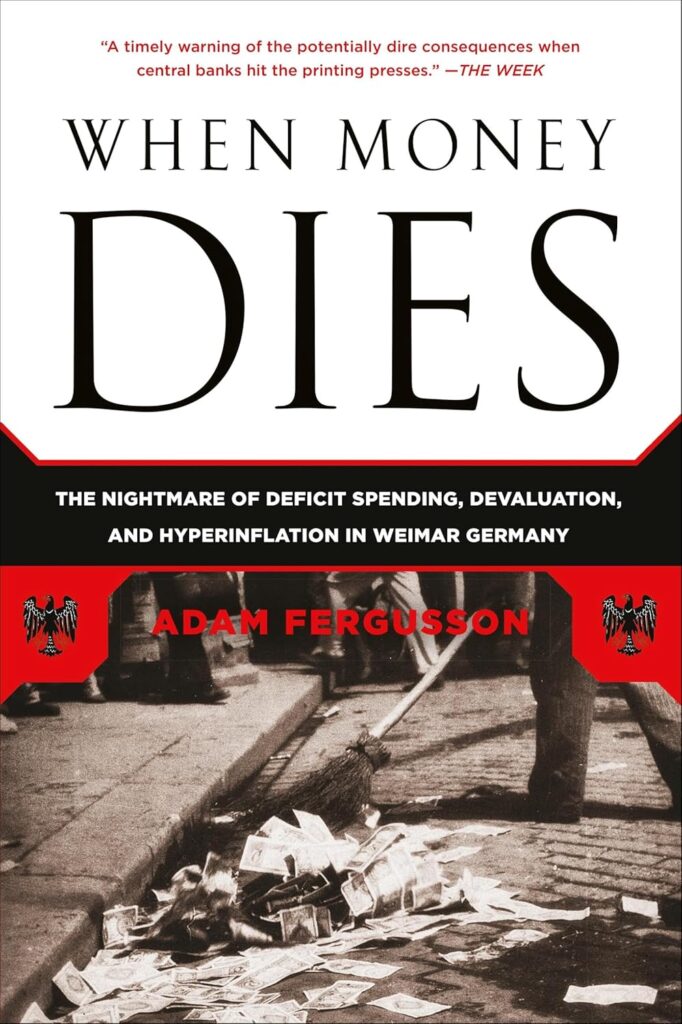
I recently read a powerful book that helps explain where this path might lead: When Money Dies: The Nightmare of Deficit Spending, Devaluation, and Hyperinflation in Weimar Germany (Amazon affiliate link) by Adam Fergusson. The book looks at how post–World War I Germany turned to reckless money printing to solve its financial problems—and paid a devastating price. Fergusson’s research offers clear warning signs for any nation caught in the same cycle.
In When Money Dies, Fergusson gives a vivid account of the Weimar Republic’s hyperinflation and the dangers of uncontrolled government spending. He shows how quick fixes, like printing more money to pay debts, caused the Mark to collapse. Prices skyrocketed so fast that people needed wheelbarrows of cash to buy bread. Beyond the economic chaos, the book reveals the human side of the disaster: families watching their savings vanish, trust in institutions crumbling, and ordinary citizens resorting to bartering or black-market trading to survive.
This book is more than a historical warning; it’s a mirror for our own times. As debt climbs and inflation lingers, Fergusson’s message rings louder than ever: hyperinflation rarely begins with bad intentions. It often starts with leaders trying to fix real problems until those fixes spiral out of control. Yet even amid crisis, Fergusson reminds us of humanity’s resilience and creativity, showing how people adapt and rebuild when economies fail.
Here are eight key lessons on inflation and currency collapse from When Money Dies.
1. Money Printing Devalues Currency
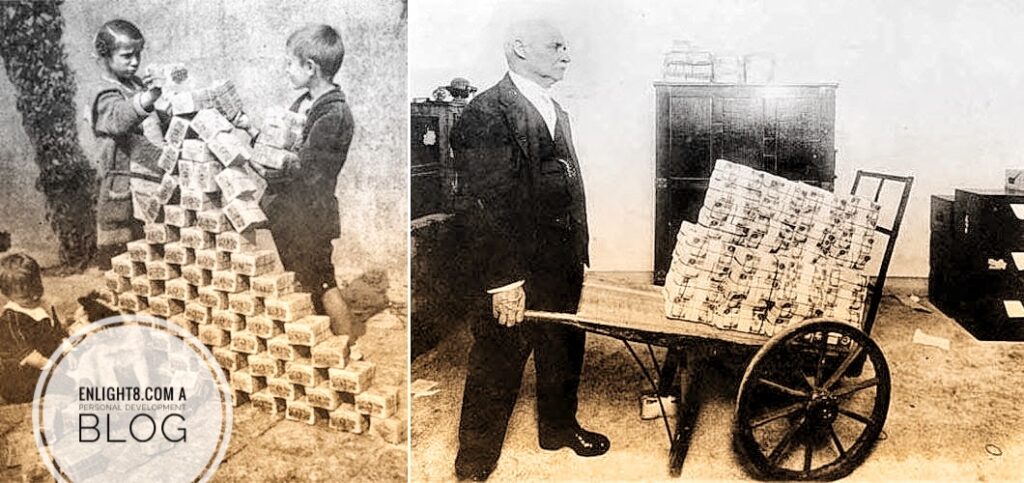
We often think that printing money can solve our financial problems, but easy money always comes with a steep price. When we rely on borrowing and creating more currency instead of balancing what we earn and what we spend, we invite long-term damage that no short-term fix can undo. Adam Fergusson’s When Money Dies reminds us of this hard truth. He recounts how post–World War I Germany, struggling under the weight of war debts and reparations, chose to print its way out of the crisis rather than restore fiscal balance. At first, it seemed to work. People had cash in their hands and the illusion of prosperity. But beneath the surface, the value of that money was quietly eroding.
Before long, the German mark collapsed. Prices exploded, and savings that families had built over generations became worthless. What happened in Weimar Germany is not just a story from another time; it’s a lesson for us today. When we depend on endless money printing and debt to keep our economy afloat, we risk repeating the same mistakes. If we want absolute stability, we must learn from history and build an economy grounded in responsibility, not illusion.
2. Dishonest Currency Leads to Corruption

In When Money Dies, Adam Ferguson reminds us that inflation doesn’t just damage economies; it reshapes and destroys entire societies. When the value of money collapses, trust crumbles, and people begin to lose faith in their government and their future. Fergusson describes how hyperinflation in Weimar Germany created desperation, corruption, and unrest, paving the way for extremist movements to rise. It is a stark reminder that when a nation’s currency fails, its people often follow it into chaos. Inflation is not only an economic issue; it is a moral and social one that tests the stability of our communities and the integrity of our institutions.
Our founders understood this danger well. In the United States Constitution, our forefathers made clear that only gold and silver should serve as real money because those metals have intrinsic value and institutions like the banks cannot print them at will. They knew that sound money protects citizens from government overreach and reckless spending. Yet today, we operate on fiat currency, paper and fiat currency created with the press of a key, backed by nothing more than confidence. Over time, this system tempts us into believing that wealth can be manufactured out of thin air, separating hard work and production from value itself.
We have seen how easy money policies promise short-term relief but deliver long-term pain. Printing money may seem like a solution to debt, recession, or political pressure, but, as Fergusson warns, it can quickly spiral into disaster. When money loses its meaning, so does accountability. If we wish to protect our economy and our freedom, we must demand honesty in our currency and responsibility in its management. Only then can we maintain the trust and stability that true prosperity depends on.
3. How Inflation Drains Wealth From Working Families

Hyperinflation is one of the most destructive forces a society can face because it quietly drains wealth from everyday people and hands it to those already in power. When prices skyrocket and the value of money collapses, our savings, pensions, and paychecks lose meaning almost overnight. In When Money Dies, Adam Fergusson describes how Germany’s middle class, who had worked hard to save and plan for the future, watched their life savings vanish as the mark became worthless. Meanwhile, those who held property, businesses, or debt often came out ahead. Debtors could repay what they owed with nearly useless currency, while speculators and the wealthy bought tangible assets at bargain prices. The result was a deep divide between the struggling majority and a small class that knew how to profit from chaos.
As our own nation wrestles with rising debt and persistent inflation, we can see how the same pattern threatens us. When the value of our currency weakens, it doesn’t just affect numbers on a balance sheet; it reshapes society itself. The rich have tools to protect and grow their wealth, but ordinary workers and retirees do not. Fergusson’s warning is clear: monetary collapse erodes fairness and fuels resentment, leaving behind a society where trust and unity are replaced by frustration and inequality. If we want a stable and just economy, we must protect the integrity of our money before it loses the power to protect us.
4. Money Printing Is Not A Fix

When governments face an economic crisis, the instinct is often to print more money in the hopes that the problem will resolve itself. However, as history demonstrates, this approach typically worsens the situation. In When Money Dies, Adam Fergusson describes how Germany’s central bank, the Reichsbank, continuously flooded the economy with new paper marks to cover debts, pay wages, and maintain an appearance of stability. Instead of solving the issues, they destroyed the value of their currency. Prices doubled within days, and paychecks became worthless before people could even spend them. What began as a short-term effort to alleviate hardship accelerated the country’s financial collapse and deepened the pain for millions.
We can learn from this lesson, as our leaders today face similar temptations. Printing money and avoiding difficult fiscal choices may seem like an easy fix, but it merely postpones the inevitable. As Fergusson illustrates, borrowing and creating endless currency can provide temporary relief, but it ultimately leads to greater instability and a loss of public trust. Real solutions require restraint, honesty, and the courage to live within our means. If we ignore this lesson, we risk repeating the cycle of quick fixes that lead to long-term economic and social disasters.
5. Monetary Breakdown Leads to Social and Political Upheaval

When a nation’s money loses its value, its society soon follows. In When Money Dies, Adam Fergusson shows how the collapse of the German mark in the 1920s destroyed more than an economy; it shattered trust, order, and hope. As inflation spiraled out of control, ordinary Germans watched their savings evaporate and their livelihoods crumble. With prices changing by the hour and wages worth less each day, people turned to desperate measures to survive. Fergusson details how looting, crime, and corruption spread through cities as faith in the government and financial institutions disintegrated. When money stopped serving as a reliable measure of value, so did the systems that held society together.
This environment of chaos and despair opened the door for extremist movements that promised order and stability, no matter the cost. Many Germans, exhausted by uncertainty, looked for anyone who could restore normalcy, and in that vacuum, Adolf Hitler and the Nazi Party rose to power. Fergusson’s account reminds us that the collapse of a currency is never just an economic event. It is a social and political earthquake that shakes our communities, our values, and our freedoms. If we allow our own monetary system to decay through reckless spending and debt, we risk repeating the same mistakes. We must protect both the stability of our society and the stability of our economy, as they are deeply interconnected.
6. When We Stop Paying Attention, Collapse Follows
Before a powerful financial crisis, there are always warning signs. But too often, we ignore them. We tell ourselves that “things have always been this way” and that somehow, the system will fix itself. In When Money Dies, Adam Fergusson reveals how many Germans in the early 1920s believed their inflation was temporary, convinced that their government or central bank would restore order soon enough. Instead, the situation worsened month after month until the fabric of society unraveled. Shops emptied, workers demanded wages twice a day, and neighbors lost faith in one another as survival instincts replaced community trust. The breakdown of sound money didn’t just make people poorer; it changed how they saw right and wrong, breeding selfishness, greed, and anger.
We face similar risks when we grow complacent about our own economy. The erosion of trust in our currency happens gradually and quietly. The more money we print and the more debt we take on, the more we weaken the foundations that hold our society together. Fergusson reminds us that moral decay and social division often begin with financial instability. When people lose faith in money, they soon lose faith in fairness, in government, and in each other. That is why maintaining sound money is not just an economic goal; it is essential to preserving our freedom, stability, and unity. If we fail to act, what seems unthinkable today may become tomorrow’s reality.
7. Real Tangible Assets as Survival Tools

When paper money loses its value, real, tangible assets become our lifeline. In When Money Dies, Adam Fergusson describes how, during the German mark’s collapse, those who owned gold, silver, land, or even livestock were far better off than those who held only banknotes. As the currency lost value by the hour, ordinary families who had saved their entire lives found themselves trading furniture, jewelry, and heirlooms to buy food. Meanwhile, those who held genuine goods or access to foreign currency could survive and even help others in need. Fergusson’s account demonstrates that during a monetary crisis, what truly holds value is not what can be printed, but what is honest, finite, and trusted.
We can take this lesson to heart in our own uncertain times. As our national debt climbs and inflation lingers, we must think critically about what “wealth” really means. Gold, silver, land, and even new forms of digital scarcity like Bitcoin have something that paper money lacks, built-in limits that preserve value when systems fail. These assets cannot be created out of thin air, making them a safeguard when trust in institutions weakens. If we face a monetary breakdown, our survival will depend not on how much money we hold but on the tangible assets and value we can exchange. The message is clear: in times of crisis, tangible wealth becomes our shield against uncertainty.
8. Recovery Requires A Drastic and Hard Reset

Reasonable recovery from a monetary collapse rarely comes from minor adjustments or temporary fixes. It demands a complete reset, a rebuilding of trust, discipline, and values. In When Money Dies, Adam Ferguson shows how Germany, after years of chaos and worthless currency, had to start over entirely. The introduction of the Rentenmark in 1923 marked a turning point, not just because it was a new form of money, but because it was backed by something real: land, property, and faith in a new system. Overnight, prices stabilized, wages became meaningful again, and business slowly returned to life. But this recovery didn’t happen automatically. It required courage, honesty, and a collective decision to abandon the illusions that had caused the disaster in the first place.
For us, the lesson is clear. When a currency system collapses, we cannot simply print our way out or pass superficial reforms. We must confront the root causes, such as reckless spending, political denial, and moral decay in the management of our finances. A true recovery means resetting not just our financial structures but our mindset about what money represents. If we continue down a path of endless borrowing and inflation, no amount of technical tinkering will restore trust once it is lost. We will need a system built on transparency and genuine value and one that rewards work and production instead of credit and speculation.
Fergusson’s story of Germany’s return to stability is both a warning and a source of hope. It reminds us that restoration is possible even after collapse, but only if we have the will to start fresh. We must be prepared to demand accountability from our leaders, embrace fiscal responsibility, and rebuild confidence in our institutions. The road to recovery is never easy, but history shows that with discipline and unity, we can redefine our economy on solid ground once again.